
Yes, Odoo is an approved platform. Your Odoo still has to be ready
On 22 April 2026, Odoo announced that it had been registered by the French tax authority (DGFiP) as an approved e-invoicing platform, a "plateforme agréée" or PA. In practice, a company on a recent version of Odoo can send and receive its e-invoices without subscribing to an outside platform. It still has to be on the right version, switch the service on properly and have clean data.
Since 1 September 2026, every VAT-registered company in France must be able to receive e-invoices, and large and mid-sized companies must also issue them. Small businesses and micro-enterprises follow on 1 September 2027. We cover the timeline and the checklist in our article on e-invoicing in France. Here we answer the question we hear most at the moment: what does Odoo's approved platform status change, and what do you need to do on your side?
In this article
Approved platform: what are we talking about?
Under the reform, an invoice between two French companies no longer goes straight from your software to the customer's mailbox. It goes through an approved platform, formerly called a PDP: the seller's platform passes it to the buyer's, and the relevant data is shared with the tax authority. Only platforms registered by the DGFiP can play this role; their list is published on impots.gouv.fr.
Until now, an Odoo user therefore had to pick an outside approved platform and connect it to Odoo. Now that Odoo is an approved platform itself, that link disappears: invoices are sent and received from Odoo, through Odoo's service. Odoo presents the service as free for sending and receiving; check the terms that apply to your contract when you switch it on.
Which Odoo versions are covered?
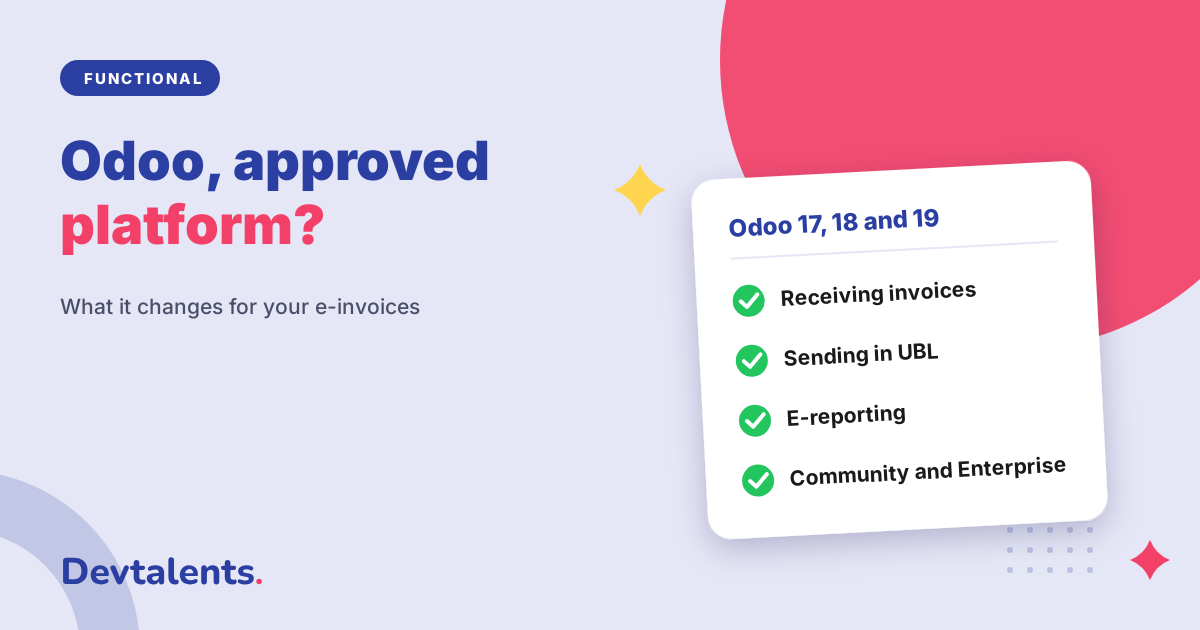
The official module, "France - E-Invoicing (Approved Platform)", exists for Odoo 17, 18 and 19, and of course on Odoo Online. It is part of the French localisation and released under an open-source licence: it works with Community as well as Enterprise, on Odoo.sh as on your own server.
It does not exist for Odoo 16 or earlier versions. If your database still runs on one of them, you have two options: migrate to a recent version, or use an outside approved platform connected to your Odoo. The first is almost always the sounder choice, because the rules of the reform will keep changing and new Odoo versions will follow them. We prepare this kind of migration with a dry run on a copy of the database: see our Odoo migration page.
What Odoo's platform does
Sending customer invoices
Invoices to your French business customers are sent from Odoo, one by one or in batches. Their delivery status shows on the invoice, and any rejection appears in its history.
Receiving vendor bills
Odoo fetches incoming invoices several times a day and creates them as drafts. You confirm them, or refuse them with a reason that is passed on to the supplier.
E-reporting
Transactions that do not go through an e-invoice, such as sales to consumers and international sales, are reported to the tax authority automatically, every ten days.
Formats
Odoo sends in UBL and accepts the three formats of the reform on reception: Factur-X, UBL and CII. Your suppliers do not have to adapt to you.
Invoices to the public sector remain separate: they go through Chorus Pro, with a dedicated module of the French localisation.
How to switch it on
- Check your company record: SIREN, VAT number and full address.
- Enable e-invoicing in the accounting settings, French section.
- Have your legal representative confirm the registration: they receive a code by email, have their identity checked with an ID document, then e-sign the statement that appoints Odoo as your approved platform.
- Choose the journal that will receive vendor bills, and enable e-reporting if it applies to you.
Your company appears in the e-invoicing directory the next day: your suppliers can then send you their invoices. Registration also makes you reachable on the European Peppol network, used in particular in Belgium.
What most often gets in the way
Switching the service on takes little time. Data quality is what takes time. Here is what we fix most often for our clients:
- Customers without a SIREN. It is the identifier used to find your customer in the directory. Without it, the invoice cannot go through the platform. Clean this up before the deadline, starting with your biggest customers.
- Badly formed invoice lines. Each line needs a product or a label, and exactly one tax. Misused comment lines and lines with two taxes are rejected.
- A legal representative who is hard to pin down. The statement cannot be signed by the accounting team on their behalf. Book the slot.
- Old customisations. A modified invoice template, a specific numbering or a custom module can get in the way of e-invoice generation. Test on a copy of your database with real invoices, in both directions, before going live.
Keeping another approved platform is possible
Nothing forces you to use Odoo's platform. Your accountant or your bank may already offer theirs, or your group may have chosen one for all its subsidiaries. In that case, Odoo has to exchange invoices with that platform through a connector. It is a perfectly reasonable choice, especially if you are on a version of Odoo older than 17 or if several applications issue your invoices. You simply need to weigh its cost and upkeep. We build this kind of link: see our custom Odoo connectors.
FAQ
How can I check that Odoo really is an approved platform?
The official list of registered platforms is published by the DGFiP on impots.gouv.fr. It is the only authoritative reference, for Odoo as for any other platform.
Do I need Odoo Enterprise?
No. The module is part of Odoo's French localisation, released under an open-source licence: it also works with the Community edition, from version 17.
We are on Odoo 16: what should we do?
The module does not exist for version 16. You can migrate to a recent version, which we recommend, or connect your Odoo to an outside approved platform in the meantime.
Does a small business need to switch everything on now?
Receiving has been mandatory since 1 September 2026; issuing will be from 1 September 2027. Switching reception on now lets you receive invoices from suppliers already subject to the obligation, and prepare for issuing without rushing.
Can you help us?
Yes: checking and cleaning customer and supplier data, activation, tests on a copy of the database, migration if your version is too old, or a connector to another approved platform.
Is your Odoo ready for e-invoicing?
Tell us which version of Odoo you use and how you invoice today: we will tell you what is left to do, and in what order. Let's talk about your project, or see our Odoo functional and technical consulting.