
Odoo can be free. An Odoo project never quite is
"Odoo is free": the sentence is both true and misleading. There is an open-source edition with no licence fee, and even a free online plan for one app. But what you will pay depends on the edition, the hosting and above all on what it takes to make Odoo fit your business. Here is how to find your way before comparing quotes.
We give no prices in this article: Odoo's price list changes regularly and is published on odoo.com. Instead, we explain what each option covers, what it leaves out, and the costs most often forgotten in a budget.
In this article
Two editions: Community and Enterprise
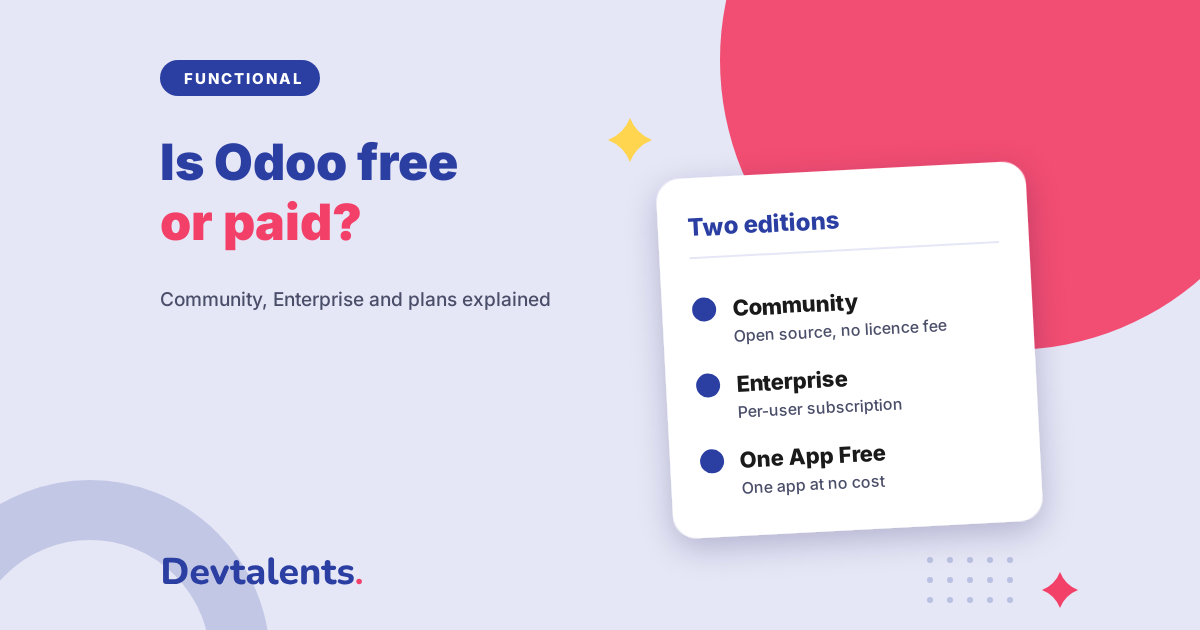
Odoo Community
The open-source edition. No licence fee, no subscription to Odoo: you install it on your own server and do what you like with it. It already covers a lot: sales, CRM, purchasing, inventory, invoicing, point of sale, website and online shop, projects.
Odoo Enterprise
The subscription edition, billed per user. It includes Community and adds exclusive apps and features, hosting by Odoo if you wish, support from the publisher and its upgrade service from one version to the next.
The two are not mixed in one database: a database is either Community or Enterprise. Moving from Community to Enterprise along the way is still possible, and it is a fairly common path as a company grows.
What Community does not include
Before going for the open-source edition, check that you will not need what is reserved for Enterprise. The gaps that weigh most often in our projects:
- Full accounting. Community lets you invoice and track payments, but accounting in the full sense, with bank synchronisation, assisted reconciliation and financial reports, belongs to Enterprise. For a company that keeps its books in Odoo, this is often the deciding point.
- Odoo Studio, the no-code customisation tool: in Community, the slightest adaptation means development.
- Several business apps, such as customer support (Helpdesk), electronic signature or document management.
- Odoo's upgrade service. To change versions on Community, you rely on community tools or on an Odoo partner.
Good news, on the other hand, for French e-invoicing: the official module that connects Odoo to its approved platform is part of the open-source edition, from version 17. We explain it in Is Odoo an approved e-invoicing platform?
Odoo's subscription plans
On the Enterprise side, Odoo offers three plans:
- One App Free: a single app, free, with unlimited users, hosted on Odoo Online. Handy to start with a CRM or invoicing, but limiting as soon as you want to connect two parts of the business.
- Standard: all apps, hosted on Odoo Online, with no non-standard modules.
- Custom: everything above, plus Odoo Studio, multi-company, access to the interfaces used to connect other software, and the choice of hosting: Odoo Online, Odoo.sh or your own server. The cost of Odoo.sh then comes on top of the subscription.
One thing to know: installing Studio or adding a second company automatically moves the database to the Custom plan. And as soon as you need a module that Odoo does not provide, such as a bank connector or a link with your online store, the Standard plan is no longer enough. Our article Odoo Online, Odoo.sh or your own server covers that choice in detail.
The costs people forget
The licence is almost never the biggest line in an Odoo project. What really counts:
- Implementation: analysing your processes, configuration, data migration, user training. This is what makes a project succeed or fail.
- Adaptations: a specific module, a connector, a document template. They cost something to develop, then something to maintain with every new version.
- Hosting and operations: free in appearance on your own server, but someone has to back up, monitor and apply security fixes.
- Version upgrades: Odoo supports each major version for three years. A migration belongs in the budget, especially if you have specific modules.
That is why a "free" Community database can end up costing more than an Enterprise subscription, if it forces you to develop what the paid edition already provides. The reverse is true too: a company that needs neither full accounting nor Studio can do very well with Community.
So, Community or Enterprise?
Community is a good fit if your accountant keeps your books in their own software, if your needs are mainly about sales, purchasing, inventory or the website, and if you have a provider or a team to host and evolve the database.
Enterprise is the obvious choice if you want to keep your accounts in Odoo, if you count on Studio or the exclusive apps, or if you would rather leave hosting and upgrades to the publisher.
If in doubt, do the maths over three years rather than the first year: licence, implementation, adaptations, hosting and one version upgrade. Over that period, the comparison becomes a fair one.
FAQ
Why is Odoo free?
Because the Community edition is open-source software. Odoo funds its business through the Enterprise edition, its subscriptions and its hosting services. The free version is complete for many uses, but it does not include everything.
Is the "One App Free" plan really free?
Yes, for a single app, with unlimited users, on Odoo Online. As soon as you add a second app, you move to a paid plan.
Can we move from Community to Enterprise later?
Yes. The database is kept: the Enterprise modules are installed and the subscription is taken out. The compatibility of any specific modules already in place still needs checking.
What about your payment modules?
They work with Community as well as Enterprise, on Odoo.sh or on your own server. Only Odoo Online does not accept them.
Can you help us estimate our project?
Yes. We start from your processes and current tools to recommend an edition, a plan and a hosting option, and give you an estimate that covers the implementation, not just the licence.
Community or Enterprise: shall we talk?
Tell us about your business and your tools: we will tell you which edition and plan fit, and what your project will really cost over time. Let's talk about your project, or see our Odoo functional and technical consulting.